In academic writing, crafting a persuasive argument is only half the battle. To earn top marks in a university essay, you must also demonstrate critical thinking by anticipating and addressing opposing viewpoints. This is where the rebuttal comes in.
Learning how to write a rebuttal in an argumentative essay is one of the most valuable skills you can develop as a student. A well-constructed rebuttal does not simply dismiss an opposing argument — it systematically analyzes its weaknesses, presents credible evidence, and reinforces your own thesis statement.
Whether you are writing an undergraduate term paper or seeking professional essay writing services to refine your writing, understanding how to construct a robust rebuttal paragraph will elevate your academic work.
What is a Rebuttal in an Academic Context?
Before diving into the structure, it is essential to define what a rebuttal is and how it differs from related academic writing concepts. In a university essay, an argumentative structure usually involves three key elements:
- The Claim: Your primary argument or thesis statement.
- The Counterargument: An opposing argument or perspective that challenges your claim.
- The Rebuttal: Your response to the counterargument, where you show why the opposing view is incorrect, incomplete, or less logical than your own.
As scholar David Schneer (2014) highlights in his research on rethinking the argumentative essay, traditional essay structures often oversimplify argumentation by treating it as a one-sided presentation of facts. In reality, academic discourse is an ongoing dialogue. Introducing a counterargument and executing a thoughtful rebuttal demonstrates that you have engaged deeply with the existing literature.
Why a Strong Rebuttal is Crucial for Your University Essay
A common mistake among students is ignoring opposing viewpoints entirely, fearing that acknowledging them will weaken their thesis statement. However, academic research suggests the opposite is true.
According to Wingate (2012), many university students struggle to understand that writing an essay is not merely an information-dumping exercise, but a sustained, evidence-based argument. By introducing and refuting a counterargument, you show the reader that you possess strong critical thinking skills, your argument is resilient, and you maintain an academic tone.
Furthermore, Ozfidan and Mitchell (2020) identified that one of the primary difficulties students face in argumentative writing is the inability to structure counterarguments and rebuttals effectively, often leading to a disjointed essay structure. Overcoming this hurdle is key to moving from a passing grade to a high-distinction mark.
How to Structure a Rebuttal Paragraph in an Argumentative Essay
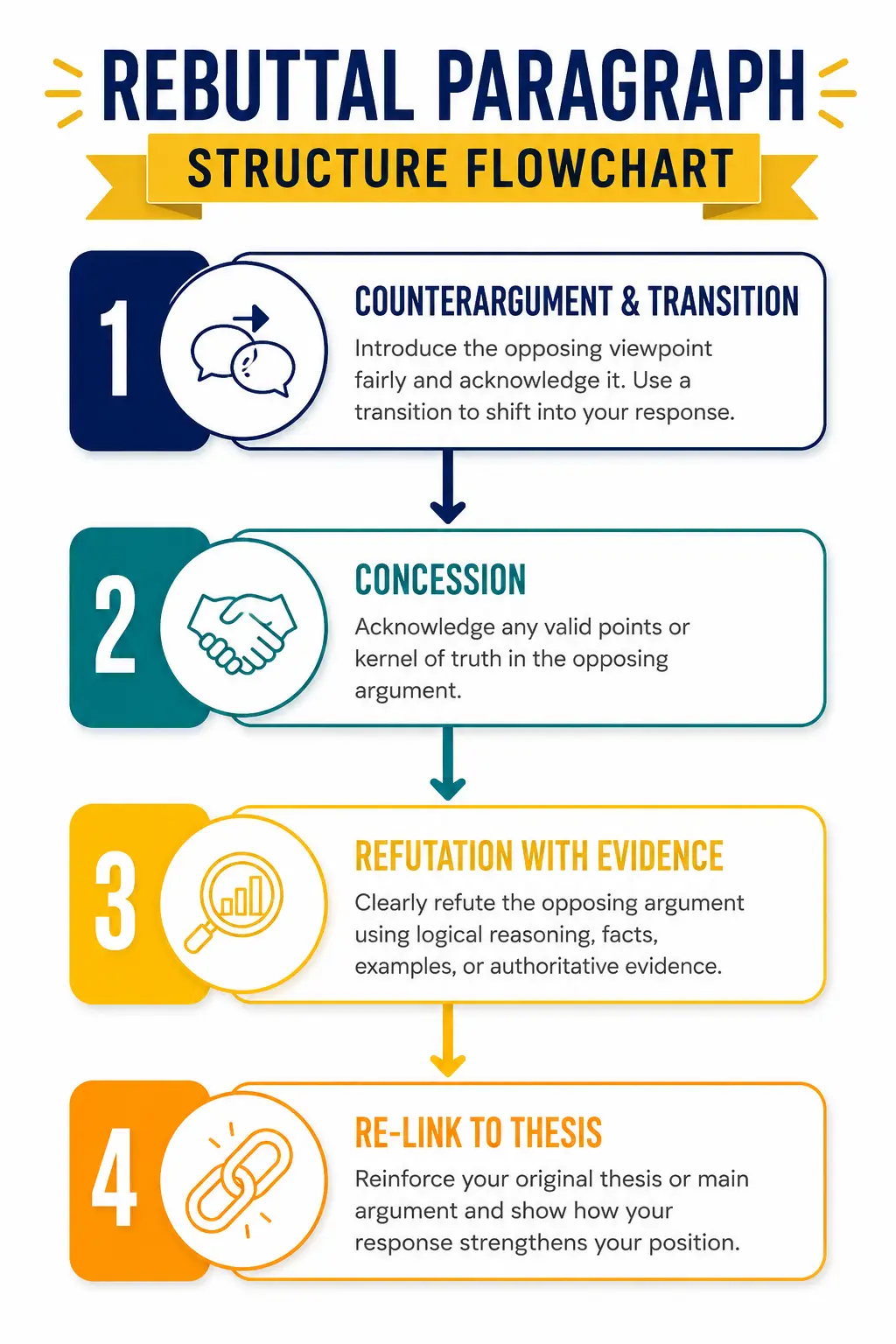
To maintain clarity and flow, a rebuttal paragraph in argumentative essay writing should follow a logical, step-by-step structure. If you struggle with organizing your paragraphs, seeking professional editing and proofreading can help refine your paper's structural flow.
A highly effective rebuttal paragraph structure consists of four core elements:
| Step | Component | Purpose |
|---|---|---|
| 1 | Transition & Counterargument | Clearly state the opposing view using transition words. |
| 2 | Concession (Optional) | Acknowledge any valid points the opposition makes to show objectivity. |
| 3 | Refutation / Counter-Evidence | Introduce academic evidence that exposes the flaws in the counterargument. |
| 4 | Conclusion / Re-Linking | Connect the paragraph back to your central thesis statement. |
Step-by-Step Guide: How to Write a Good Rebuttal in an Argumentative Essay
Step 1: Identify the Strongest Counterargument
Do not choose a weak or easily dismissed counterargument — often called a "straw man" fallacy. Instead, select the most compelling, logical argument that opponents use against your thesis. Addressing a strong opposing argument makes your subsequent refutation far more persuasive.
Step 2: Decide on Concession vs. Refutation
When you address a counterargument, you have two primary options:
- Concession: You acknowledge that the opposing argument has a valid point, but show that your thesis is still more significant (e.g., "While it is true that X has short-term costs, the long-term benefits far outweigh...")
- Refutation: You argue that the opposing view is entirely incorrect, outdated, or based on flawed logic and insufficient data.
Step 3: Use Effective Transition Words — How to Start a Rebuttal
Knowing how to start a rebuttal is crucial for maintaining academic tone. Avoid aggressive phrases like "My opponents are completely wrong." Instead use professional academic transitions:
- "Critics of this theory argue that... However, this view overlooks..."
- "While it is often claimed that... closer examination of the data reveals..."
- "Admittedly, some evidence suggests that... nonetheless, the broader implications indicate..."
- "Although proponents of X maintain that... their analysis fails to account for..."
Step 4: Present Solid, Credible Evidence
An argumentative essay is only as strong as its evidence. When refuting the counterargument, do not rely on personal opinion — introduce peer-reviewed research, statistical data, or historical precedents. If you find it challenging to source credible academic literature, investing in professional research paper writing assistance can ensure your arguments are supported by high-quality, peer-reviewed sources.
Step 5: Link Back to Your Thesis Statement
Every body paragraph must serve your central argument. End your rebuttal paragraph by explicitly stating why the failure of the counterargument strengthens your overall thesis statement.
Rebuttal Paragraph Examples With Analysis
Rebuttal Paragraph Example 1: Policy and Social Sciences
Context: An essay arguing that universal basic income should be implemented to mitigate economic inequality.
Thesis Statement: Universal basic income is a necessary economic tool to reduce poverty and provide stability in an increasingly automated job market.
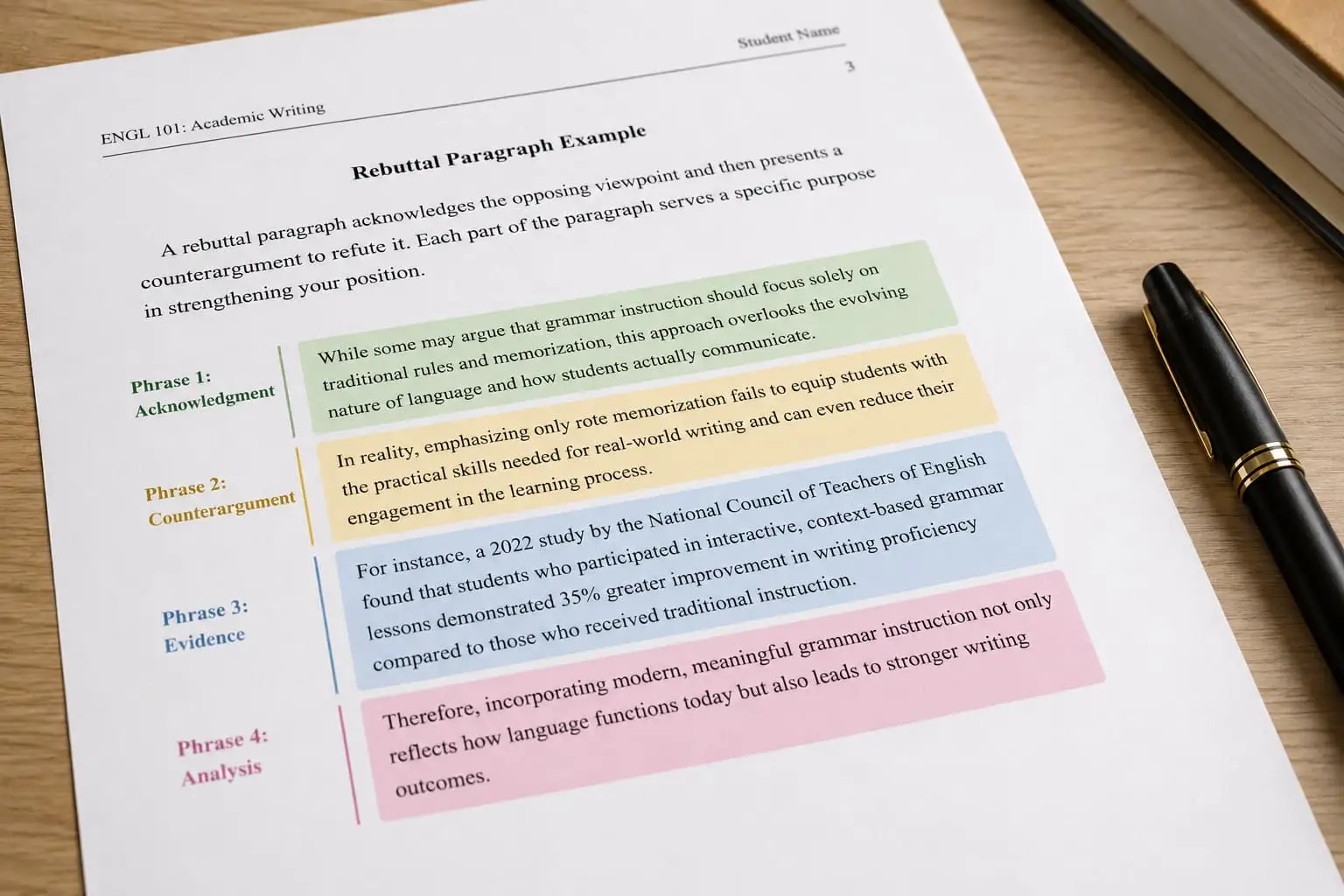
Opponents of universal basic income frequently argue that providing unconditional cash transfers to citizens would disincentivize work, leading to labor shortages and economic stagnation. Admittedly, early economic theories suggested that unearned income might reduce the motivation to seek employment. However, contemporary empirical data contradicts this assumption. A comprehensive study of UBI-style programs across multiple nations shows that unconditional cash transfers do not cause a significant decline in employment rates. Therefore, the claim that UBI diminishes productivity is unfounded, and the policy remains a highly viable solution for reducing systemic poverty.
Rebuttal Paragraph Example 2: Science and Technology
Context: An essay arguing that AI should be integrated into university classrooms rather than banned.
Thesis Statement: Academic institutions should actively integrate generative AI tools into their curricula to prepare students for the future workforce.
Critics of generative AI in higher education contend that these tools encourage academic dishonesty and hinder the development of students' critical thinking skills. While concerns regarding academic integrity are understandable, outright bans fail to address the realities of a technology-driven workforce. Research in digital pedagogy suggests that when instructors actively teach students how to co-write and critically evaluate AI outputs, students develop stronger analytical skills. Consequently, banning these tools is counterproductive — integrating them responsibly is the only way to cultivate the digital literacy skills required in modern professional landscapes.
Advanced Rebuttal Strategies for Postgraduate and PhD Students
At the postgraduate and doctoral levels, writing a rebuttal requires a more sophisticated approach. As Bradford (2022) observes, the way academic arguments are constructed varies significantly across disciplines. In the hard sciences, a rebuttal might rely heavily on statistical anomalies. In the humanities, a rebuttal often involves questioning the theoretical framework or ideological biases of the opposing researchers.
In a study on the argumentative writing behavior of graduate learners, Abdollahzadeh et al. (2017) noted that successful academic writers frequently use hedging and boosting devices to manage their claims:
- Hedging (e.g., suggests, indicates, might) — allows you to present your rebuttal without sounding overly aggressive.
- Boosting (e.g., clearly, demonstrates, establishes) — helps you assert your evidence with confidence when the data is solid.
If you are struggling to structure complex scholarly arguments in your postgraduate research, seeking professional thesis and dissertation help can provide the structured guidance and academic expertise necessary to elevate your doctoral or Master's thesis.
How to Write a Rebuttal for a Debate vs. an Essay
| Oral Debates | Written Essays |
|---|---|
| Dynamic, real-time response | Anticipatory argument |
| Shorter, conversational tone | Formal, academic tone |
| Focuses on oral delivery | Heavily cited evidence |
| Identifies immediate flaws | Structured integration |
Common Mistakes to Avoid When Writing a Rebuttal
- Using a Straw Man Fallacy: Do not misrepresent or oversimplify the opposing view to make it easier to attack.
- Ad Hominem Attacks: Never attack the character of writers who hold the opposing view. Keep your critique focused on logic and evidence.
- Lack of Evidence: Simply stating that the counterargument is incorrect is not enough. You must prove it with credible, cited academic literature.
- Losing Your Voice: Ensure that the counterargument does not overwhelm your paragraph. Your thesis statement should remain the dominant force.
Frequently Asked Questions
What is a rebuttal in an argumentative essay?
A rebuttal is the section of an argumentative essay where you address and refute a counterargument. Its purpose is to show why the opposing claim is weak, invalid, or less logical than your own, thereby strengthening your central thesis statement.
How to write a good rebuttal in an argumentative essay?
To write a good rebuttal, first state the counterargument clearly and objectively. Then introduce credible peer-reviewed evidence that exposes the limitations or flaws in that opposing argument. Finally, explain how your evidence proves your thesis statement remains correct.
How do you start a rebuttal?
You can start a rebuttal using academic transition phrases such as "While some researchers argue that...", "Critics contend that...", or "Admittedly, opponents of this view point to..." followed by your counter-evidence.
What are some examples of a rebuttal?
In an essay on environmental policy, a rebuttal might state: "While critics argue that transitioning to renewable energy is too costly in the short term, economic analyses demonstrate that the long-term savings on public health and disaster relief far outweigh the initial investment."
Need Help Crafting the Perfect Argumentative Essay?
Writing a persuasive, well-structured rebuttal requires deep research, critical thinking, and a polished academic tone. At ThesisArcPro, our team of academic writing specialists helps undergraduate, postgraduate, and PhD students across the UK, USA, Australia, and Canada.
- Professional essay writing services and structure development.
- Expert editing and proofreading services.
- Comprehensive research paper writing and sourcing.
- Specialist thesis and dissertation help and consultation.
Contact our expert team today to get started and elevate your academic performance.
Get Professional Essay Help →References
[1] Abdollahzadeh, E., Amini Farsani, M., & Beikmohammadi, M. (2017). Argumentative writing behavior of graduate EFL learners. Argumentation, 31(4), 641-661. Source
[2] Bradford, J. (2022). Constructing an argument in academic writing across disciplines. ESP Today. Source
[3] Schneer, D. (2014). Rethinking the argumentative essay. TESOL Journal, 5(4), 619-653. Source
[4] Wingate, U. (2012). Argument! Helping students understand what essay writing is about. Journal of English for Academic Purposes, 11(2), 145-154. Source
[5] Ozfidan, B., & Mitchell, C. (2020). Detected difficulties in argumentative writing. Journal of Ethnic and Cultural Studies, 7(2), 15-29. Source