Completing a Master's degree is a significant academic milestone, and for many postgraduate students in the UK, USA, and Australia, writing a master's thesis is the final, most demanding hurdle. This extensive academic writing project requires independent research, critical analysis, and the ability to contribute valuable insights to your field of study.
Navigating this process can feel overwhelming. Managing a large-scale research project while meeting strict university guidelines requires structured planning, sustained focus, and refined academic skills. If you are feeling stuck or pressed for time, seeking professional thesis and dissertation help can provide the structured guidance and feedback you need to keep your research on track.
This comprehensive guide breaks down the process of how to write a master's thesis step by step. We will cover everything from initial planning and structuring your chapters to formatting your final draft and preparing for your thesis defense.
Master's Thesis vs. PhD Dissertation: Key Differences
Before diving into the writing process, it is helpful to clarify what a master's thesis is and how it differs from a doctoral dissertation.
| Feature | Master's Thesis | PhD Dissertation |
|---|---|---|
| Primary Goal | Demonstrate mastery of a specific topic and deep understanding of existing research. | Produce entirely original research that contributes new knowledge to the field. |
| Scope & Depth | Focused, narrower scope; builds upon existing research frameworks. | Broad, highly detailed scope; involves extensive multi-year empirical research. |
| Typical Length | 12,000 to 25,000 words. | 60,000 to 100,000+ words. |
| Timeframe | Usually 6 to 12 months. | Typically 3 to 5+ years. |
| Defense | Often requires oral defense or presentation. | Always requires rigorous oral defense before an academic committee. |
How to Start a Master's Thesis: Planning and Preparation
A successful thesis is built on a foundation of careful preparation. Jumping straight into writing without a clear plan often leads to structural issues, wasted time, and unnecessary stress.
Formulating Your Research Question and Thesis Statement
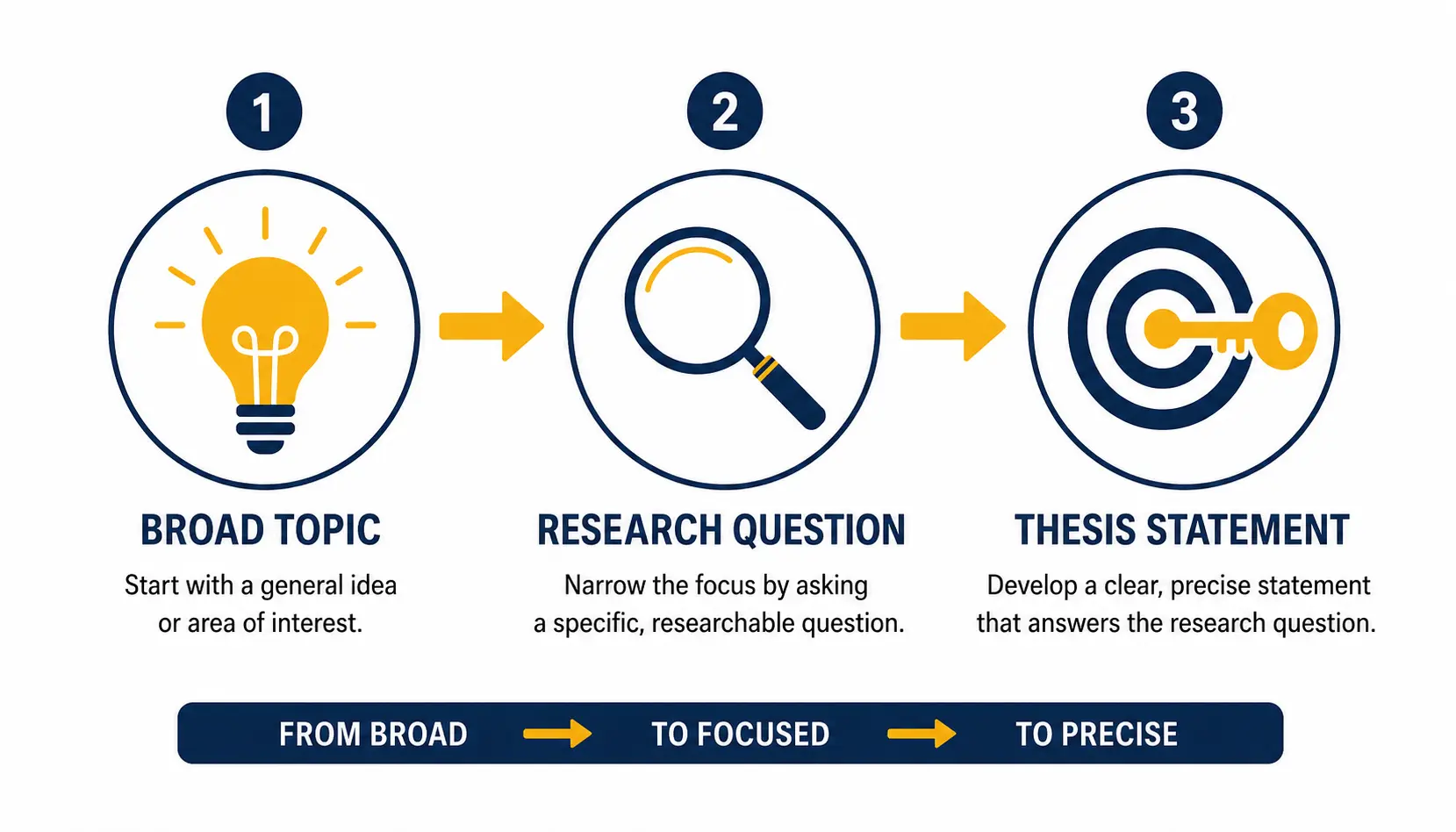
The first step in learning how to start a master's thesis is identifying a viable research topic. Choose a subject that genuinely interests you, as you will be working closely with it for several months. A strong research question should be:
- Clear and focused: Avoid broad generalizations; specify the exact variables, population, or context you are studying.
- Feasible: Ensure you can access the necessary resources and data within your timeframe.
- Analytically complex: It should require analysis and argument rather than a simple yes or no answer.
How to Write a Master's Thesis Proposal
Before you are permitted to write your actual thesis, most postgraduate programs require you to submit a formal thesis proposal. A typical master's thesis proposal includes:
- Introduction: An overview of the topic and its academic significance.
- Literature Review (Preliminary): A brief summary of existing research to establish the gap your study aims to address.
- Research Questions / Hypotheses: Clear statements of what you intend to investigate.
- Proposed Research Methodology: An explanation of how you will collect and analyze data.
- Timeline and Resources: A realistic schedule showing how you will complete the work.
Writing a proposal requires a distinct tone. If you find yourself struggling to organize your initial ideas, utilizing professional essay writing services for early-stage drafting and structure planning can help clarify your direction.
The Standard Master's Thesis Structure and Format
Most academic institutions require a standardized master's thesis structure. Here is what it typically includes:
Title Page and Front Matter
- Title Page: Includes your thesis title, name, degree, institution, department, supervisor name, and submission date.
- Abstract: A concise summary of 150 to 300 words outlining the research problem, methodology, key findings, and conclusions.
- Table of Contents, List of Figures, and List of Tables.
- Acknowledgements: A brief section to thank supervisors and participants.
Introduction and Literature Review
The Introduction introduces the research topic, provides background context, states your research question, and outlines the significance of your study. The literature review is a critical synthesis of existing academic work that identifies gaps your research addresses.

Research Methodology and Data Analysis
The research methodology section must describe exactly how you conducted your research. You need to explain your research design, data collection methods, sampling strategy, and data analysis techniques. Writing this section with absolute clarity is essential for academic credibility. If you need support structuring your empirical design, reaching out for professional research paper writing support can help you present your methodology clearly and accurately.
Discussion, Conclusion, and Referencing
In the Discussion chapter, you interpret your findings in relation to your original research question and existing literature. The Conclusion summarizes the entire thesis and answers your research question clearly. Finally, include a comprehensive reference list following your university's preferred format whether APA, Harvard, Chicago, or MLA.
How to Write a Master's Thesis Step by Step
To make this extensive project manageable, follow this practical roadmap:
- Step 1: Establish a timeline working backward from your submission deadline.
- Step 2: Conduct a systematic literature search using Google Scholar, Scopus, or your university library.
- Step 3: Write the methodology section while your research design is fresh.
- Step 4: Draft your body chapters — literature review, results, and discussion.
- Step 5: Write the introduction and conclusion last for greater accuracy.
Polishing Your Thesis: The Final Review and Defense
Structural Editing and Proofreading
When reviewing your first draft, focus first on higher order concerns — is your argument logical, do paragraphs transition smoothly, are headings consistent? Once satisfied with structure, focus on line editing and proofreading. This stage can be incredibly tedious, especially when you have spent months on the same text. Seeking professional editing and proofreading services can provide an objective expert review to ensure your work meets high academic standards.

Preparing for Your Thesis Defense
Depending on your university's regulations, you may be required to complete a thesis defense or viva. To prepare:
- Practice explaining your research question, methodology, and key findings in a 10 to 15 minute presentation.
- Anticipate potential questions regarding your study's limitations and methodological choices.
- Remember the defense is an academic conversation — defend your decisions constructively while remaining open to scholarly feedback.
Frequently Asked Questions
How to write a master's thesis step by step?
Writing a master's thesis step by step involves choosing a focused research topic, formulating a clear research question, drafting and submitting a thesis proposal, conducting a systematic literature review, designing and executing your research methodology, analyzing your data, drafting your core chapters, and finally revising, proofreading, and formatting before submission.
What is the format of a master's thesis?
A standard master's thesis format typically consists of a title page, abstract, table of contents, introduction, literature review, research methodology, results, discussion, conclusion, and reference list. The specific citation style such as APA or Harvard depends on your university guidelines.
What are the 5 rules of a thesis statement?
A strong thesis statement should be: Specific — focused on a precise aspect of your topic. Debatable — takes a clear stance requiring evidence. Clear and Concise — stated in one or two well structured sentences. Justifiable — supported with credible evidence. Directional — previews the structure and main arguments of your research.
How to start with your master's thesis?
Begin by identifying a broad area of interest within your discipline. Read widely to locate gaps in current research, formulate a specific research question, and discuss your ideas with a potential supervisor. Once you have their feedback, draft a formal thesis proposal to establish your research scope, timeline, and methodology.
Achieve Academic Excellence with ThesisArcPro
Writing a master's thesis is a challenging, long-term commitment that tests your academic abilities and time management skills. At ThesisArcPro, we offer reliable professional academic support tailored to postgraduate students in the UK, USA, and Australia. Our dedicated specialists can assist you at any stage of your research journey whether you need help defining your research question, structuring your literature review, designing your methodology, or conducting a thorough final proofread.
- Professional thesis and dissertation help and consultation.
- Expert research paper writing and sourcing.
- Comprehensive editing and proofreading across APA, Harvard, Chicago, and MLA styles.
- Early stage essay writing services and structure planning.
Let us help you present your research with clarity and precision. Contact ThesisArcPro today to discuss your project requirements.
Get Started Today →